Quantitative Methods
Lecture 1 – Slides 16-25
2020-07-06
What is Statistics?
The practice of collecting and collating numerical facts
- Goes back to beginning of human civilization.
- … in 1749, word Statistik introduced by Gottfried Achenwall.
- From the Latin statisticum (“of the state”).
- It designated the collection of data about the state.
The Definition of Statistics
- The process of reasoning about the data collected
Inferential statistics:
- Parameter estimation
- Hypothesis testing
Why do we need statistics?
- What is biology about?
- What is economics about?
- What is sociology about?
- …What is statistics about?
Statistics is about variation.
Statistics helps us make sense of the data and how the data vary.
Statistics is a collection of conceptual and mathematical tools that allow us to study such variation.
Why is Statistics important for Psychology?
The use of Statistics qualifies Psychology as a science…
Using statistics we can determine whether a psychological hypothesis is true for a wider population, or whether a treatment works or not.
Statistical methods provide a unifying force within Psychology.
What’s the origin of Statistics?
Starting from the 17th century, Statistics (the process of reasoning about the data) originated from different fields:
| Demography |
Statistical summaries |
| Astronomy |
Theory of errors, normal distribution |
| Gambling |
Probability theory |
| Agriculture |
Experimental design |
What’s the origin of Statistics?
Let’s take a step back…
In 1687 Newton published Principia Mathematica
- Laws of motion, gravitation
- Now it’s possible to predict mathematically the movement of objects, including stars!
But what about other complex phenomena?
What’s the origin of Statistics?
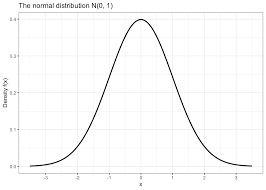
At some point it was found that many events follow what we call a normal distribution.
How did they find out?
![]()
What’s the origin of Statistics?
Starting from the 17th century, Statistics (the process of reasoning about the data) originated from different fields:
- Demography → statistical summaries
- Astronomy → theory of errors → normal distribution
- Gambling → probability theory
- Agriculture → experimental design
Demography
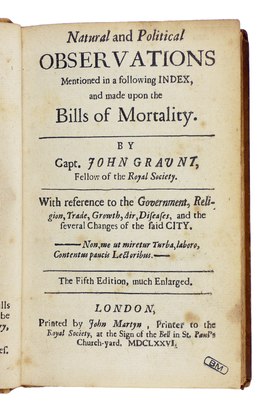
John Graunt, a London haberdasher, born in 1620, tried to predict and explain social phenomena from tables he compiled from the “Bills of Mortality”.
Astronomy
For science to progress, scientists propose hypotheses to test.
In order to do that, they need to collect data…
In order to collect data, scientists must make experimental measurements.